
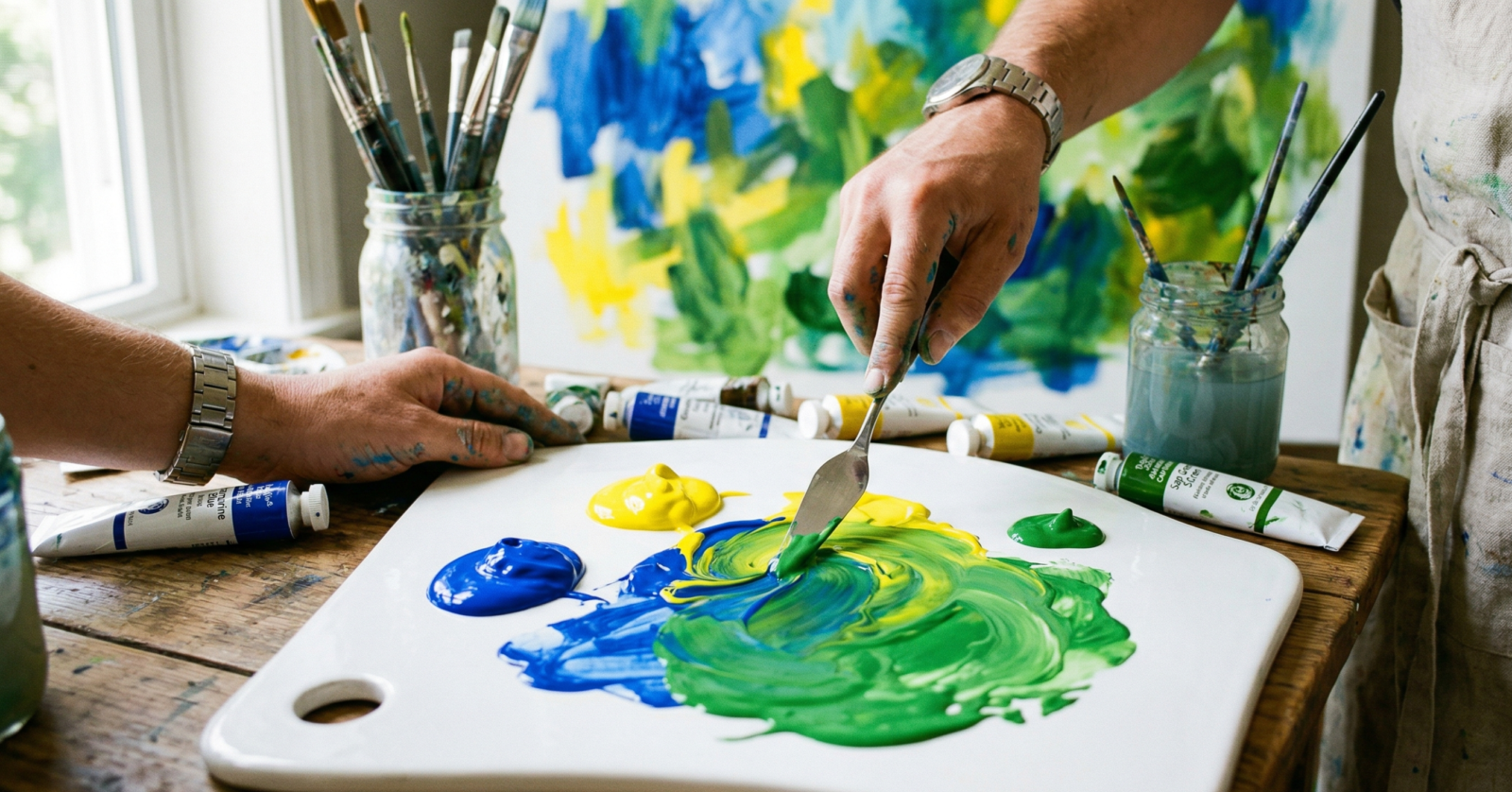
If you’ve ever found yourself asking, “blue and yellow make what colour?” the short answer is green. But the long answer? That’s where the real magic happens.
Understanding how these two primary colors interact isn’t just for painters; it’s for decorators, designers, and anyone who wants to understand the visual world a little better.
The Science Behind the Hue
To understand why blue and yellow create green, we have to look at the physics of light and pigment. In the world of art, we use the Subtractive Colour Model.
- Primary Colours: Red, Blue, and Yellow.
- Secondary Colours: Created by mixing two primaries.
When you mix blue and yellow, you are essentially “subtracting” or absorbing certain wavelengths of light. Blue paint absorbs long-wavelength light (reds and oranges), while yellow paint absorbs short-wavelength light (blues and purples). The only wavelength they both reflect is the middle of the spectrum: Green.
Shades of Green: Not All Greens are Equal
While the basic answer to “blue and yellow make what colour” is green, the type of green depends entirely on the specific “bias” of the paints you are using. If you’ve ever mixed a muddy, dull green when you wanted a bright lime, it’s likely because of the undertones in your primary colors.
- Warm Blue (Ultramarine): This blue has a hint of red in it. If you mix this with yellow, that tiny bit of red will “dull” the green, resulting in a more olive or earthy tone.
- Cool Blue (Cerulean): This blue leans toward green. When mixed with yellow, it creates a vibrant, electric green.
- Warm Yellow (Cadmium Yellow Deep): This has a lean toward orange. Mixed with blue, it creates a more muted, natural forest green.
- Cool Yellow (Lemon Yellow): This is a “pure” yellow. It creates those crisp, bright greens we see in spring leaves.
Practical Applications: Beyond the Canvas
Knowing that blue and yellow make what colour is useful in more places than you might think:
- Gardening: Understanding these tones helps you choose foliage that complements your flowers.
- Photography: Post-processing often involves balancing yellow and blue sliders to fix the “tint” of a photo, directly affecting the greens in the landscape.
- Fashion: Color blocking yellow and blue creates a high-contrast, bold look, but wearing a green that is a perfect “child” of those two specific shades creates a harmonious, monochromatic feel.
Quick Mixing Guide
If you are experimenting at home, use this quick reference table to achieve the specific green you’re looking for:
| Desired Result | Mix This |
| Lime Green | Lots of Lemon Yellow + A tiny drop of Bright Blue |
| Forest Green | Ultramarine Blue + A touch of Warm Yellow |
| Mint Green | Blue + Yellow + A generous amount of White |
| Olive Green | Blue + Yellow + A tiny dot of Red (or Burnt Sienna) |
Conclusion
So, the next time you see a lush meadow or a deep emerald gemstone, remember that it all comes back to that fundamental partnership. While the simple answer to blue and yellow make what colour is green, the reality is a vast spectrum of possibilities.
Color mixing is a language. By changing the ratio of your blue and yellow, you aren’t just changing a hue; you’re changing a mood, a feeling, and a piece of art. Grab some paint, start experimenting, and find the specific shade of green that speaks to you. After all, the best part of art isn’t just knowing the answer—it’s seeing it happen on the paper.